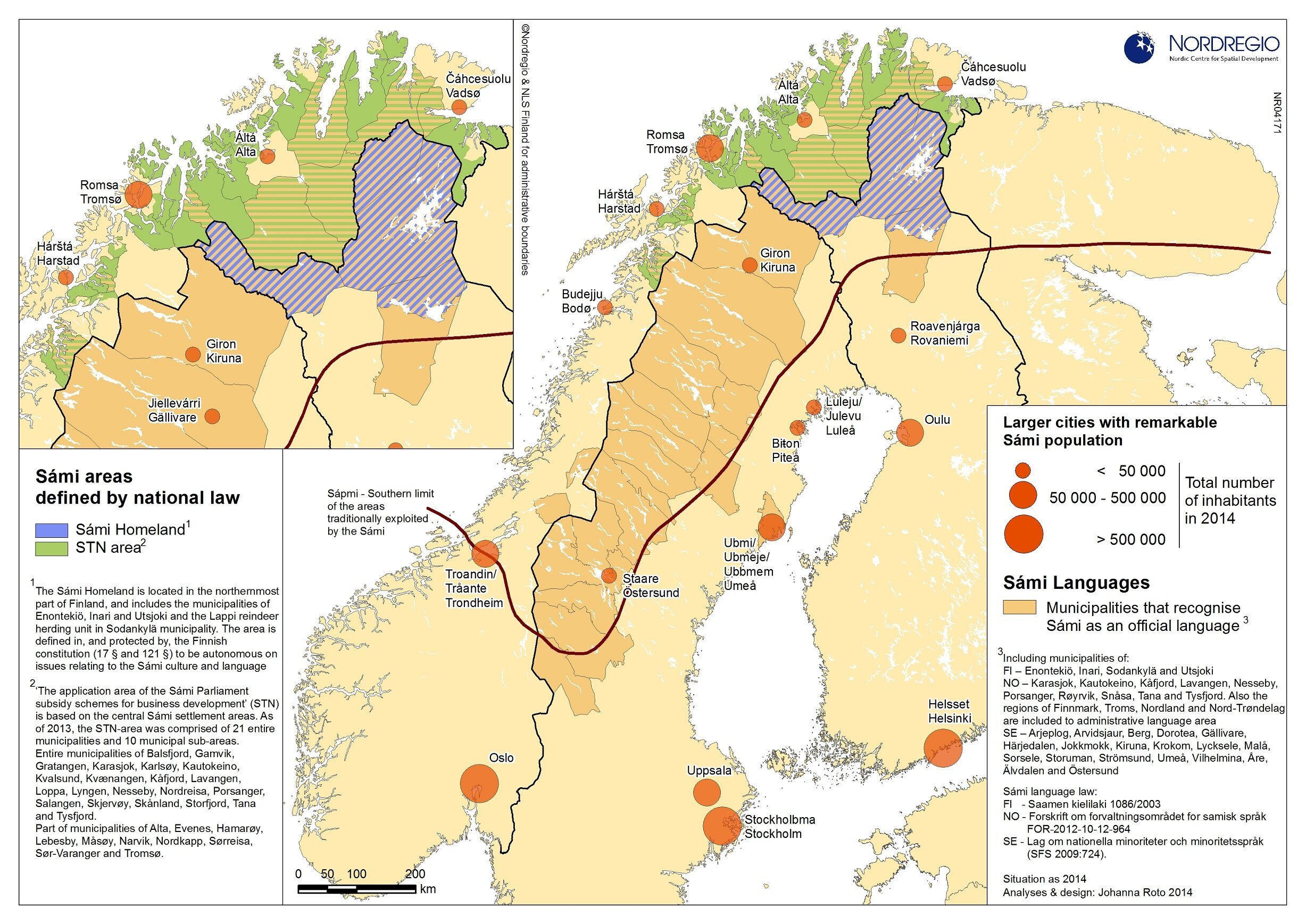
This map shows the traditional lands of Sápmi as defined by the countries that contain Sámi population, and features cities that had a large Sámi population as of 2014. Note that this map does not reflect the traditional lands of Sápmi as understood by Sámi; for example, there is no recognition by the Russian government.
One people among four nations. There is no consensus on contemporary Sámi population counts. Some say between 50,000 and 80,000; others say the number is closer to 200,000. The majority of Sámi today live in Norway (about 55%), in Sweden (about 40%), in Finland (about 7%), and in Russia (about 2%). Sápmi, the home of the Sámi, stretches over northern Scandinavia to the Kola Peninsula, largely above the Arctic Circle.
The Sámi are an Indigenous people who share a common identity yet are as diverse as the different natural environments and whose culture is directly connected to the land they have lived on and used since time immemorial, from taiga to forest to coast. Sámi culture is directly connected to these lands and their flora and fauna. Awareness of and symbiosis with the natural world is integral to the Sámi luondi, or way of being.
These days, Sámi live and work all over the world.
The Sámi languages are part of the Finno-Ugric branch of the Uralic language family and are distantly related to Finnish, Estonian, and Hungarian.
There are nine living Sámi languages, and several more that have died out under pressure from colonization and from increasing numbers of non-Sámi settlers living in Sápmi. While many Sámi continue to speak a Sámi language, at least half do not. There are increasing efforts to preserve and spread the use of Sámi languages. For example, Google Translate includes North Sámi (the most-spoken of the Sámi languages) in its offerings, and there are apps available that assist those learning it. South Sámi is spoken by the second-highest number, among the nine.
Some of the countries that contain Sápmi are now including Sámi languages on important signage, such as those welcoming travellers to various municipalities where Sámi languages have designated minority-language status.
While many Sámi continue to speak the Sámi language of their ancestors, at least half do not. Many among the younger generations are eager to reclaim their ancestral language.
For most of their known history the Sámi lived in small hunting and gathering communities known as siidat (singular: siida). Each siida consisted of members of several family groups, and was associated with a specific geographical area. A council of elders made decisions for the siida, and resources were shared among siida members. About 400 years ago, however, this siida system began to give way to large-scale reindeer herding due to increasing pressures from outsiders on the wild reindeer herds on which many Sámi depended for food, leather, and other products. Large-scale reindeer herding meant that herding Sámi had to follow the migration routes of the reindeer across the old siidat boundaries, including across internationally recognized national boundaries, which led to significant changes in society. The states made laws determining who was “real” Sámi and discriminated against any who kept livestock other than reindeer, or who engaged in forestry, fisheries, and hunting rather than herding. The forced assimilation, displacement, and erasure had repercussions that continue today in living rooms and courtrooms. Less than 10 percent of Sámi are currently involved in reindeer herding.
That is the tiniest tip of the iceberg, however. Learn more below:
Samer.se A rich resource from the Sametinget (Swedish Sámi Parliament)
Say it in Saami Quick Quide to Sámi Culture
Better yet, become a member. You will gain access to additional resources, and with your membership, help support our work in expanding awareness and understanding.